Share This Post Today!


Lange Nelle Lighthouse, Flanders, Belgium
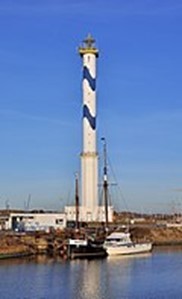
This coastal lighthouse is located on the Belgian coastline of the North Sea. The lighthouse was originally constructed in 1771. The current structure opened in 1949 and stands at 190 feet in height. The lighthouse is 213 feet above sea level.
Akmeņrags Lighthouse, Pavilosta, Latvia
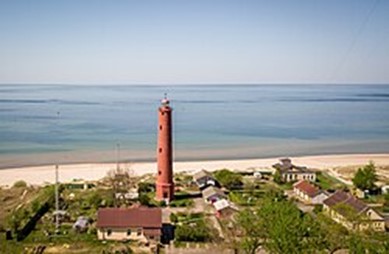
This lighthouse is located on the west coast of Latvia in a resort town. The lighthouse serves as a key navigation point in one of the most dangerous spots in the Baltic Sea. The original lighthouse opened in 1879, and the current structure opened in 1921.
*Feel free to send us your photos of Lighthouses to be featured in our weekly market observations.
Happy New Year
Yes, we know it’s a little late, but we wanted to wish you a Happy New Year directly from this commentary. We hope you and your families had a safe, happy, and healthy holiday season.
Venezuela
This week, we will be jumping mainly into one topic, as it has dominated the news this week. We did some very in-depth research, which we will be sharing in the coming weeks. This week, we outlined the overall landscape of Venezuela and what is to come. We will dive into more detail on the energy industry and names we like in the next few editions of this commentary. We hope you enjoy this week’s edition.
Over this past weekend, the U.S. sent troops to Venezuela to arrest and capture the Venezuelan President. Trump has been warning Maduro for months regarding action. U.S. troops have been stationed off the coast of Venezuela and in the Caribbean for almost 6 months. The U.S. has been sinking and intercepting vessels in the region with the stated goal of combating drug trafficking.
President Maduro has served as the leader of Venezuela since 2013; before that, he worked under President Hugo Chavez. Maduro is a dictator who utilizes hard-line “modern socialism”, which involves a state-run economy. This economic model was utilized by Chavez and evolved under Maduro has oppressed the people of Venezuela for decades. Maduro has been indicted since 2020 under narcoterrorism charges. Maduro was indicted alongside numerous associates, his wife, and Colombian guerrilla groups. Maduro and his associates have been accused of transporting cocaine into the U.S.
Five years after being indicted and Maduro and his wife were captured and arrested by a U.S. Delta team in Caracas and transported to New York City to be processed.
This was huge news for the world. Everyone had a reaction. The people of Venezuela and those with Venezuelan heritage took to the streets to celebrate the end of this dictatorship, which had been going on for years. Former president Chavez and his successor Maduro had oppressed its population through poor economic policy, authoritarianism, and corruption. The oppression began in the late 1990s when Hugo Chavez was elected President of Venezuela. Fast forward 25 years, and the results are unimaginable. Socialism outright failed, Chavez and Maduro enriched themselves and caused numerous economic issues, including hyperinflation, stagnant growth, increased unemployment, and major instability. Maduro has also labeled himself “a man of the people” despite being extremely corrupt, having his opponents killed, and not accepting election results. Numerous countries sanctioned Maduro back in 2018 regarding the Venezuelan election, which looks to have been stolen.
Despite broad-ranging support for Maduro’s arrest, many questioned the method that the Trump administration used in order to arrest him. The mission was not approved by Congress, and very few knew about this international mission that arrested a foreign head of state.
So why has Venezuela essentially become a failed state? Two brutal dictators who operated hard-line socialism for decades, whose policies stunted growth, caused inflation to surge, and forced businesses to become state-run.
Venezuela was once the most stable and wealthy Latin American nation, and one of the wealthiest in the world in terms of GDP per capita.
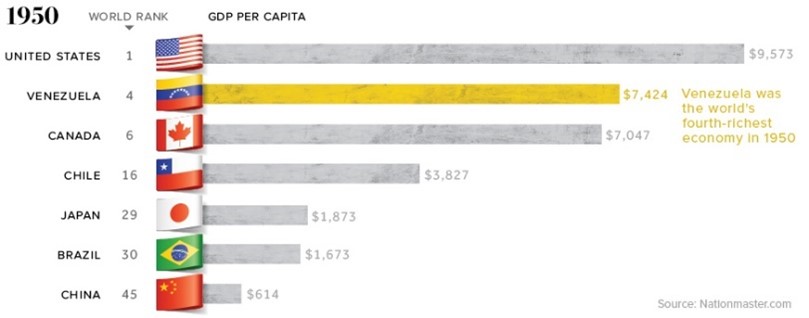
Today, Venezuela’s GDP per capita trails every nation in South America. GDP per capita in Venezuela essentially did not move from 1980 to 2023, according to the IMF:

Policies have failed and left the people of Venezuela behind. Maduro has ignored the will of the people on numerous occasions and has not respected democracy. The socialist dictatorship of Venezuela was a failed experiment and was something many wanted to end. Most developed countries have sanctioned Maduro and his allies and have shrunk trade with the country due to Maduro’s corruption and brutality. The U.S. and its allies have been pushing nations to stop purchasing Venezuelan oil as its sale finances a large portion of their budget. Today, Venezuela has aligned itself with the likes of Cuba, China, Russia, and Iran.
It has not always been like this for the people of Venezuela. Decades ago, the population thrived on the back of strong natural resource sectors and tourism. Today, not so much. Venezuela is home to the world’s largest oil reserves (self-reported and unaudited from Hugo Chavez, who reclassified some heavy oil reserves), but the country cannot get oil out of the ground anymore (it is the world’s 21st largest producer). Today, Venezuela produces one-third of what it produced in the early 1990s.
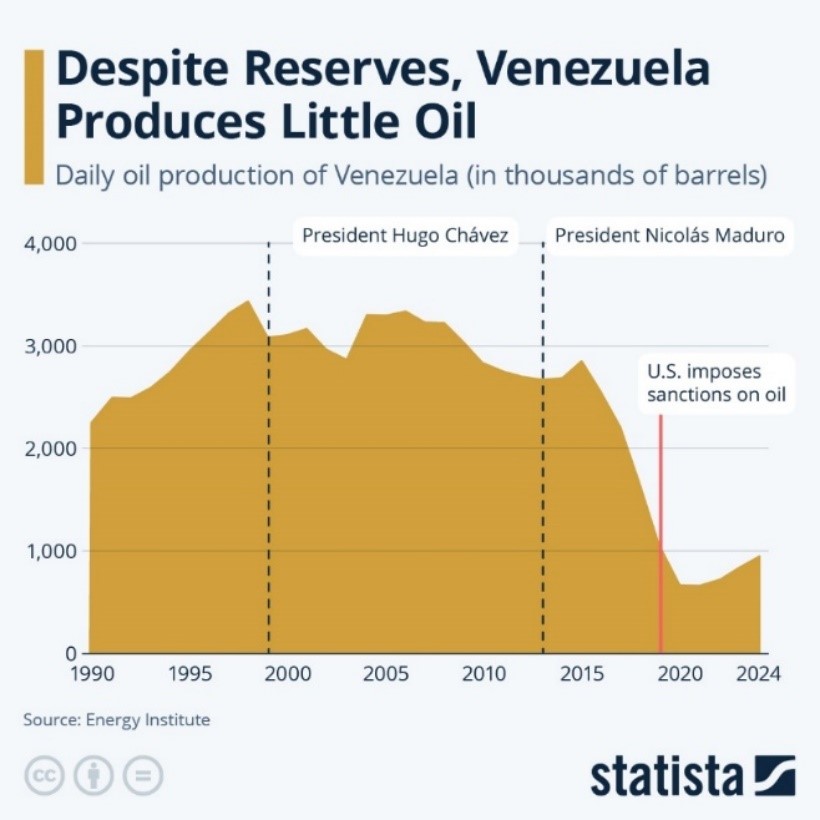
Many have speculated that Trump only took Maduro and sent troops to Venezuela to grab control of Venezuela’s oil reserves. While that might be partially true, Trump has been steadfast on his approach against Venezuela for years (check the dates of the articles below):
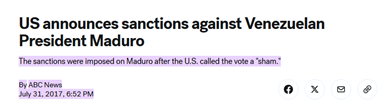
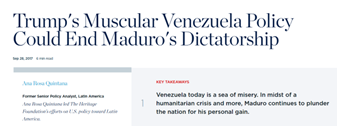
While Trump’s method to achieve Maduro’s capture might be over the top and correlate with other Trump interests, he did something many believed was not possible: successfully arrest a corrupt foreign leader.
Trump wants to increase oil production and continue to decrease prices. Lower oil prices will be deflationary and will further tame inflation. Venezuela nationalized some of its oil reserves beginning in the 1970s. However, in 2007, Hugo Chavez nationalized all private operations, including those of firms like ExxonMobil and ConocoPhillips. International arbitrators have awarded these private firms billions, but Venezuela has been slow to pay. Now, Venezuela cannot produce nearly as much oil due to socialist mismanagement, which caused a budding industry to screech to a halt. The country once earned billions in taxes and royalties from oil, then got greedy and wanted it all.
Venezuela’s government has had issues with production in recent years due to several factors. The country has not had sufficient capital to upgrade old pipelines and drill sites, and has not developed the technology to process and refine heavy oil in volume. The country’s infrastructure is in despair, and energy infrastructure continues to physically deteriorate.
Most of Venezuela’s oil reserves are what you would call “heavy oil”, which is a very thick, dense crude oil that does not flow easily due to large, complex molecules, high viscosity, and high specific gravity, often containing more sulfur and metals than light oil. Heavy oil requires specialized techniques like heating or dilution for extraction and processing. Heavy oil is essentially degraded conventional oil. U.S. sanctions have also played a factor in crippling Venezuela’s oil industry. Heavy oil is very costly to refine and could increase costs for consumers due to the heavy processing.
U.S. firms previously operating in Venezuela had developed the technology to transport and refine this type of oil. In recent years, only Chevron was active in Venezuela, but it was under strict production guidelines and rules due to an operating waiver with the Venezuelan government. Other firms had to abandon their projects due to the instability of Venezuela’s government and its seizure of control of production.
According to Trump and his allies, the U.S. will control Venezuela’s oil supply and will remain present in the country for now. However, it looks like Venezuela’s new leader will be Maduro’s second in command, and it looks like she cut a deal with the Americans to save herself and get rid of Maduro (all speculation). Many have hoped that Maduro’s removal would bring change, and a new party would lead the country. However, that does not look like the case. Venezuela’s opposition leader, who fled Venezuela for safety, Maria Corina Machado (2025 Nobel Peace prize winner), reportedly does not have the support of the Americans despite her wide-ranging support from Venezuelans. She had a stand-in candidate at the last election in 2024 after being disqualified by Maduro. Her stand-in candidate reportedly won according to various data sources and exit polls, but Maduro remained President due to voting irregularities and corruption within the National Electoral Council.
For now, there will be minimal change (in terms of party), but it looks like the Americans will be more involved. A free and fair election is what the people of Venezuela deserve. They do not deserve to be the number two in command, and the U.S. controlling their country and its resources. Many have hopes that the new President will be more with the U.S., less corrupt, and will clean out corrupt high-level officials. (We will not be holding our breath).
For us Canadians, Venezuelan heavy crude production increases present a potential problem (down the line) as this type of oil is very similar to crude found in the Alberta Oil Sands (aka “Tar Sands”). The fear from some Canadians and oil market experts is that the U.S. will eventually replace its Canadian heavy oil imports with Venezuelan heavy oil, which they control. This would shrink the bargaining power that Canada has with the U.S. when it comes to trade. U.S. Gulf refineries are built for heavy crude refining. Before sanctions were imposed in 2019, several large U.S. Gulf Coast refineries bought and processed about 800,000 bpd of Venezuela’s heavy oil, according to U.S. government data. U.S. refiners in the Gulf could be major beneficiaries down the line as according to industry experts, as they can process hundreds of thousands of barrels per day more than they already do. Companies include Valero, Phillips 66, and PBF Energy. These companies already buy Venezuelan crude from Chevron; Valero alone can take another 300,000 barrels a day, according to Barclays. These companies are ready for more Venezuelan oil and are familiar with the product.
Chevron is the only U.S. major that currently operates in Venezuela. Before the 2019 sanctions, Marathon Petroleum, TotalEnergies, and ExxonMobil purchased Venezuelan crude and are reportedly interested in purchasing more. Most world majors abandoned their projects when Chavez nationalized the oil industry in 2007.
Canada would be forced in this situation to find other buyers for their heavy oil, but they do not have the infrastructure to accomplish this (pipelines to transport oil from the Oil Sands to the West Coast). Canada reported record production in 2025, exporting about 90% of its crude exports to the U.S. The U.S. finding a new supply would be a serious problem for our country down the road.
This new oil flow would also create a problem for China, who import most of Venezuela’s oil exports (approximately 90%). China has invested over $10 billion in a strategic partnership over the years. China refines its imports of Venezuela’s heavy oil at a plant in Jieyang, the U.S. turned that tap off and cut off the supply already. The facility is now at risk of becoming obsolete.
President Xi accused the U.S. of stealing China’s oil on Wednesday after the U.S. announced plans to refine and sell 50 million barrels of Venezuelan oil (which were previously frozen under sanctions). The funds from these sales would enter a U.S. controlled account, which will be used to benefit the people of Venezuela (according to U.S. Energy Secretary Chris Wright). This oil has already been paid for by China through state-backed loans for oil deals, according to Reuters, which has angered Beijing.
This move by Trump resets the board in Latin America and boxes China out. It erases China’s access to Venezuela and shrinks its influence in the region (at least for now). China will reportedly look to Iran to fill its supply gap.
Trump could leverage Venezuela’s oil over both Canada and China for various purposes down the line. We almost certainly expect this to happen.
We will say, most of Canada’s oil exports to the U.S. flow to the Midwest to be refined. Most of this oil cannot be replaced by Venezuelan oil.
While U.S. refiners and oil company stocks have had some of the strongest starts to 2026, Canadian energy names have lagged due to long-term demand risks. We think for the most part, these moves are knee-jerk reactions. There will not be a massive supply that comes online. OPEC will more than likely balance the market down the line, net demand has not changed globally, and Canada’s oil will remain in heavy demand. There are still major risks operating in Venezuela, and it will take quite some time for production to substantially increase.
Trump is reportedly pushing for U.S. companies to spend on capex and restore the Venezuela oil industry to its former glory. According to insiders, the U.S. government would help run the industry and the country’s oil production and would split profits/royalties with companies that have claims against Venezuela, and companies that help with boosting production. However, do not expect production to immediately increase to former levels. According to Barrons, it will take $183 billion in investment to increase Venezuela’s oil production to 3 million barrels per day by 2040 (Venezuela’s peak oil production was reached in the mid-2000s). Energy research firm Rystad Energy estimates that it would cost around $53 billion over the next 15 years to keep Venezuela’s oil production flat.
That is a lot of capital to invest in a high-risk country that could see unrest for years to come. We doubt companies will be willing to spend tens of billions on what we would label as risky projects, especially when oil is trading below $60 per barrel. We think majors will need a clear view of the political landscape before investing billions into upgrading Venezuela’s energy infrastructure and expanding its production. Expect Venezuela to increase production, but not in size, over the next few years. Many processing plants in Venezuela have been operating under capacity, and with maintenance and upgrades, could increase capacity.
Venezuela also has an issue with its workforce. The sector has suffered a severe loss of skilled workers stemming from government action, which has hollowed out the workforce in the energy industry.
Beyond the financial and human capital it will take to expand production, many doubt the reported oil reserves that Venezuela has self-reported. Venezuela’s reserves jumped from 100 billion to 200 billion in 2011 and to 300 billion in 2013, according to the U.S. Energy Information Agency. Some question these self-reported moves as there was no large new discovery, and the figures could be more phantom than real. If Venezuela’s reserves are smaller than reported, it would mean their heavy oil will not be a long-term threat to Canadian heavy oil.
In terms of securities that we like and are looking after, this major event. We continue to look at U.S. refiners, U.S. oil majors, companies with claims against the Venezuelan government, shipping tanker companies, and, for our high-risk readers, Venezuelan real estate, consumer stocks, and debt.
However, we will not be quick to dump Canadian energy stocks as Venezuela risk remains; increasing production will take time, cooperation, capital, and prolonged stability. We are unsure if all those things happen at this current juncture.
Trump bans institutional home buying
On Wednesday at lunch, President Trump announced that his administration would develop a plan to ban large institutional investors from purchasing single-family homes. He stated that he will call on Congress to codify the ban. Shares of single-family home rental companies fell heavily on this news. Blackstone shares declined by 4% as did Invitation Homes and American Homes 4 Rent.
Many consumers support this move on both sides of the spectrum due to affordability issues. The plan comes after what is likely to have been the third straight year of three-decade-low home sales.
Hopefully, there is a plan in place that is actionable, and this move is not rash, as housing is highly sensitive and forced sales could cause a significant decrease in home prices.
Earlier this year, Trump said he would be announcing some of the most aggressive housing reform plans in American history.
MacNicol & Associates Asset Management
January 9th, 2026
What We Are Looking At Next Week
The coming week begins quietly on the data front, but the calm is deceptive. The most important macro development is the G7 finance ministers’ meeting, where discussions around supply chains, strategic commodities, and industrial policy will be front and center. Markets will be sensitive to any signal of coordinated action, particularly around critical inputs and trade positioning, as these themes continue to shape inflation dynamics and longer-term growth assumptions.
As the week progresses, attention will shift towards the Federal Reserve speakers, who will help frame how policymakers are interpreting recent inflation and growth data. The cutting cycle appears to be coming to an end, and so even subtle changes in tone can move rates and risk assets. We are less focused on any single comment and more on whether there is consistency–or divergence–across speakers, as that will influence expectations for policy stability versus renewed uncertainty.
Finally, earnings seasons begin to ramp up, led by major financial institutions. Bank earnings are especially important at this stage of the cycle as they offer an early read on credit conditions, loan demand, and capital market activity. Guidance will matter more than results, particularly commentary on margins, balance sheet health, and client behaviour. Together, earnings, Fed messages, and global policy coordination will set the tone for risk appetite as markets move deeper into the first quarter.
Download in PDF format: