
Share This Post Today!


Hillsboro Beach Lighthouse, Hillsboro Beach, Florida submitted by Martin M.

This lighthouse was built in 1906 by Russell Wheel and Foundry Co. of Detroit. The lighthouse stands at 147 feet tall, and the lighthouses lens was designed by a French company.
Cromwell Point Lighthouse, Country Kerry, Ireland

Source for images: Wikipedia
This lighthouse known as Valentia Lighthouse is an active 19th century lighthouse on the west coast of Ireland. The lighthouse is 15 meters tall and was automated in 1947.
*Feel free to send us your photos of lighthouses to be featured in our weekly market observations at info@macnicolasset.com.
Anthropic IPO at softer valuation
After a wild few weeks for AI companies, the highly anticipated IPO of Anthropic looks to still be on track but at a much lower valuation than previously thought.
Anthropic filed to launch its IPO on Tuesday, where it will sell 825 million class A shares at an estimated price of $70 to $78 a share. At the top end of this range, Anthropic would raise $64.4 billion through its IPO. The firm will also look to raise $26 billion in a private placement to large technology companies including Google, Microsoft, and Nvidia. Talk about even more circularity in the AI industry after these investments from hyperscalers and chip producers.
Anthropic’s current shares outstanding means it is aiming for a market value of around $1.02 trillion at its IPO. The firm’s fully diluted valuation would be $1.4 trillion when accounting for options and unvested stock awards.
This valuation would make Anthropic’s IPO the second-largest U.S. IPO behind SpaceX. Just a few months ago, it was reported that Anthropic was eyeing a valuation of $2 trillion. Since then, sentiment and volatility have changed, causing the shares of AI-related companies to pull back.
Anthropic has applied to list on the Nasdaq under the ticker ANT. The final IPO is expected on November 18th, with shares expected to begin trading on the 19th (according to sources). Anthropic’s lead book runners are Goldman Sachs and Morgan Stanley.
Anthropic’s valuation for its IPO at $1.02 trillion is only slightly above its last private round valuation. In May 2026, Anthropic raised capital in a Series H raise at a valuation of $965 billion. We think this move by management to IPO at a lower valuation is smart, as it leaves upside on the table for shares rather than shooting for the moon on valuation and having shares pull back heavily in the following days. The valuation is also not as outlandish as many forecasted, with its target IPO valuation coming in at 12x 2027 sales; for context, SpaceX shares trade at 11x 2027 sales.
Goldman expects Anthropic revenue to hit $52 billion this year and rise to $600 billion by 2030. They do not expect the firm to turn cash flow positive until 2030. The 2030 revenue target places Anthropic among the world’s largest companies in terms of sales.
One thing that differs in this IPO versus most IPOs is retail participation. According to Barron’s, Anthropic plans to allocate up to 20% of the deal to retail investors, which they disclosed in their IPO prospectus. Some of that retail exposure will be sold through the main underwriting group while other shares will be offered through retail focused firms like Fidelity, Robinhood, SoFi, and E*TRADE.
Anthropic comes into the IPO with a strong balance sheet position of $132 billion of cash and equivalents and no debt, aside from the convertibles that will be exchanged for common stock in conjunction with the IPO. Cash proceeds are forecasted to surpass $210 billion after the IPO, which would make Anthropic one of the cash-richest companies in the world, with cash per share reaching $10 to $15 depending on the final share count.
Despite its giant cash pile, Anthropic has $900 billion in future commitments, which is worrying some analysts and investors. However, only $27 billion of that comes next year. The plan for the firm moving forward is to eventually utilize operating cash flows to fund those commitments, but that could take a few years.
Although the firm’s IPO is smaller than expected, Anthropic going public is historic, especially for the AI industry. Anthropic will be the first new-age AI large language model developer to go public, and it will be the market’s second $1 trillion + IPO valuation in under six months (SpaceX). Watch its performance closely, as weak investor sentiment or demand could push markets as a whole lower.
Hot CPI print
On Tuesday morning, the U.S. Bureau of Labor Statistics released the latest inflation report. The consumer price index (CPI) rose 0.4% in October, more than expected by economists. The Core CPI number came in at 0.3% versus a 0.2% expectation.
October’s increases slowed versus September in terms of headline numbers.
Tuesday’s inflation report comes just weeks before the Federal Reserve’s last monetary policy meetings (December 8-9). Before the Bureau of Labor Statistics released the CPI report, FED Governor Christopher Waller stated that a hot inflation report would push him toward advocating for a half-point interest rate increase in December and specifically said that such a hike should be on the table if core CPI was “around 0.3%.” A few hours later, that happened, which shifted traders to now full price in a quarter-point interest rate increase and put the odds of a half-point hike in December at 13.6%.
The inflation report sent stocks lower and pushed yields higher, which Karen Manna, fixed income investment strategist at Federated Hermes, stated was the report the market could least afford to see.
In the CPI report, the Bureau of Labor Statistics did not estimate a yearly rate for inflation due to the government shutdown last year which prevented data from being collected last year. But Capital Economics North American senior economist Thomas Ryan estimates that headline inflation is now close to 4%, up from 3.7% in September.
In October, the energy index rose 0.7% while the gasoline index was up 1%. Food costs moved higher by 0.5% while transportation services jumped 0.8%. Inflation has been running above the FED’s 2% target for more than 5 years straight; the recent acceleration has been driven by the conflict in Iran and new tariffs introduced by the Trump administration. Some economists also believe hyperscaler spending is driving inflation and will continue to move forward due to energy and electricity consumption.
According to the October edition of the National Federation of Independent Business survey, 37% of businesses reported that they plan to raise prices in the next three months, the highest number since July 2022 (when inflation was surging due to the Russian invasion of Ukraine and the Western world’s policy response). We expect this to continue with no formal resolution to the conflict in Iran, which could push the FED to hike rates multiple times.
For now, it seems like the FED will hike 25 basis points in December and reevaluate at the start of 2027, where many are forecasting 2-3 more hikes.
What a Blue Congress means
Last week’s election was an outright blue wave. Both the Senate and House are now in the hands of the Democrats for the next two years. Voters rejected the last two years of Trump 2.0, which has led to further affordability issues, a new foreign war, and increased spending. Three things Republicans promised to fix after the Biden Presidency, that arguably got worse. So, what do the next two years look like? Gridlock and political theatre rather than major sweeping change. Democrats do run the House and Senate, but Trump can veto any legislation that passes.
Trump still has power despite the Blue Wave through his executive abilities. Expect him to test the limits of those powers in the next two years. Trump also has executive authority over defense, foreign policy, and in select cases, trade. So do not expect major changes in those areas from Trump unless Democrats come to the table on other areas or policies. Trump will also still hold the power of the veto, which makes wholesale change unlikely according to RBC Wealth Management.
In terms of what we expect, Democrats will likely push to minimize the Trump tariffs. We are not sure how receptive he will be to that. We also expect healthcare to benefit, driven by fewer healthcare spending cuts and a potential extension of the enhanced Affordable Care Act subsidies, which Republicans recently let expire. Some healthcare stocks could heavily benefit if there is a reversal on policy regarding these subsidies and healthcare spending.
On the AI industry and data center front, regulation looks like it will pick up and could impact certain projects. However, AI and technology companies have warned that increased regulation and moratoriums on data center projects could allow China to catch up in the AI race to the West and, more specifically, the leading U.S. companies. We are not sure what will happen, as many projects need state approval and some federal approval. There is also universal opposition to AI data centers from voters on both sides of the aisle, according to a Quinnipiac University poll from March 2026. Voters’ biggest concerns remain increased electricity costs due to these projects. We will continue to report on changes in this area due to its significance in the global economy and financial markets.
In terms of defense spending, we do not expect a major change in global spending after the election. We are in a new world where countries are increasing their spending, including across the Western world. Defense spending continues to increase for a variety of reasons, including more global conflict, other countries’ spending commitments, and bipartisan support in the U.S. to push allied nations to spend more. Although this election result may impact some defense and military spending, we still see global upside and growth, perhaps just at a lower rate than before. The U.S. is set to spend a record amount in 2026, and Trump’s proposed budget would increase that amount by 50% next year, so any cuts would be from a record level and would be significantly higher than this year’s figure. The 5% NATO target that the U.S. pushed for at last year’s Hague Summit is being honored by many nations who have increased defense and military spending substantially and will be next reviewed in 2029 after the next Presidential election in the U.S.
Crypto and bank-related stocks could struggle moving forward due to some increased regulation. The Clarity Act for crypto already failed and has hampered the crypto industry; that could continue with more oversight and regulation. Democrats could also slow the deregulation that Trump and Republicans have been pushing for in the banking sector, which could handicap its outlook. One area where Trump and Democrats could find common ground is credit card interest rates, which could be capped in the U.S. and impact issuers significantly. We will be watching policy in these areas very closely for opportunities and to monitor existing positions.
Energy policy will likely not change, but Democrats have already begun investigations into Venezuela’s regime change and the U.S.’s energy agreements with them, as well as discussions and deals the U.S. has made with Russia. Clean energy could benefit from heightened oversight over the Trump administration’s restrictions on clean energy project approvals.
We think consumer staple companies could benefit from this election result as both parties look to tackle the affordability crisis. This could come in the form of bipartisan support for low- and middle-income Americans. This is a reason many staple stocks jumped heavily on Wednesday after the election.
TD reported that a positive from these election results could be the easing of concerns about the Fed’s independence, as a Democrat run Senate would be in charge of confirming new members. There have been recent concerns regarding the Fed’s independence due to Trump’s comments regarding Jerome Powell, his nomination of Kevin Warsh, and Trump’s investigations into other members of the FED who disagree with him.
Overall, the election likely will impact certain sectors more than others. However, there are other factors that trump politics which drive equity market performance, including innovation, the FED’s policy decisions, and corporate earnings trends. Do not fixate on this election result, as historically markets have moved higher no matter the party in command in Washington.
Berky doesn’t skip a beat
Berkshire Hathaway shares continue their ascent as they freshly hit all-time highs just a few days it reported its latest earnings. Shares are up 17% year-to-date. Shares have broken out over the last 6 weeks after trading in a horizontal pattern and moving flat over the previous 5-6 months. For most of 2026 and since 2025 (when Warren Buffett announced he would be stepping down as CEO), Berkshire shares have trailed the market. That trend has reversed over the last 6-8 weeks.
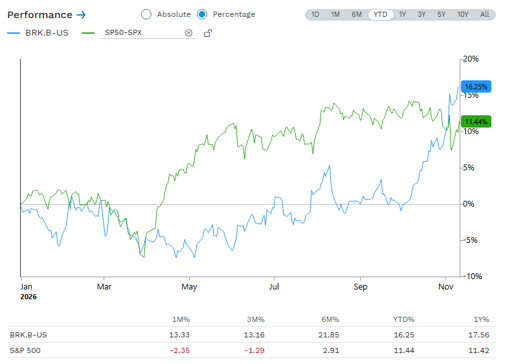
Source: FactSet
We think the recent share price surge has happened for a variety of reasons, including investor flight to safety, strong non-insurance earnings in Q3, continued share buybacks, and management finally putting cash to work through acquisitions and investments.
With recent market volatility, investors have looked for safety, with rising yields and volatile equity markets being driven by energy markets and AI sentiment / uncertainty. Investors who still want upside have rotated capital from growth-oriented names into more defensive equities which are of higher quality due to their strong cash flows. Berkshire fits that bill. Reuters stated that many investors are looking for traditional economic exposure in equities (a group of companies that together look like the economy) rather than major concentration in one industry. Berkshire also owns a few businesses which benefit from higher energy and electricity prices.
In terms of quarterly earnings, Berkshire revenue jumped 11% year-over-year, the second straight quarter with double-digit growth. Operating earnings pulled back slightly but beat street estimates by nearly 3%. The quarterly earnings decline was driven by weakness in the insurance business, including Geico. Geico’s results reflect a willingness to accept lower premiums to help regain customers lost during a multiyear effort to improve underwriting and reduce overhead. The firm reported strong noninsurance earnings. The firm’s energy, manufacturing, servicing, retailing, and railway businesses all had increased operating earnings year-over-year on a quarterly and first nine months of the year basis.
Berkshire continued its share buyback in the third quarter, buying back $9.6 billion in shares, bringing their total buybacks for 2026 to $14.4 billion. The Q3 2026 figure jumped over 130% YoY. The firm also stated that it repurchased $2 billion more in shares in October. 2026 is the largest buyback year since 2021 for Berkshire.
These quarterly results also reflect Berkshire’s acquisitions of Occidental Petroleum’s chemical division (closed in January) and Taylor Morrison (closed in July). The two acquisitions totaled $16.2 billion.
In terms of equity investments, Berkshire raised its stake in Bending Spoons, an Italian AI company, by $330 million. It also raised its combined Alphabet position and is now the firm’s third-largest stock holding behind Apple and American Express. The firm also reportedly made small purchases of a few other positions (the firm’s 13F will be released next week so we can report on actual figures).
Between the share repurchases, acquisitions, and stock purchases, Abel is putting Berkshire’s enormous cash pile to use, something the legendary Warren Buffett was hesitant to do at the end of his tenure. Berkshire’s cash pile has decreased by nearly $24 billion over the last 6 months (as of 09/30). This shows Abel is attempting to deliver value in today’s markets. It also reflects his view of Berkshire shares, which trade near 1.4x book value. Abel’s aggressive purchasing of Berkshire shares this year shows his intrinsic view of Berkshire shares. We share the same view of the company and continue to see more upside. We also think insurance figures will continue to improve and push headline results higher in quarters to come.
Disclaimer: MacNicol & Associates Asset Management holds class B shares of Berkshire Hathaway across various client accounts.
What we are watching next week
After a busy week of earnings and the U.S. Bureau of Labor Statistics reporting CPI data, the market continues to be volatile. Next week, all eyes will be on Nvidia’s earnings as the company’s latest figures will give guidance on the state of the AI industry and spending across the industry. Beyond Nvidia, Anthropic’s looming IPO (scheduled for November 19th) is something we will be watching as market sentiment has been soft in recent months, and this giant IPO is the first pure play on a large, long language model developer in public markets. On the economic side, industrial data and jobless claims will be released, which could give further color on the state of the U.S. consumer.
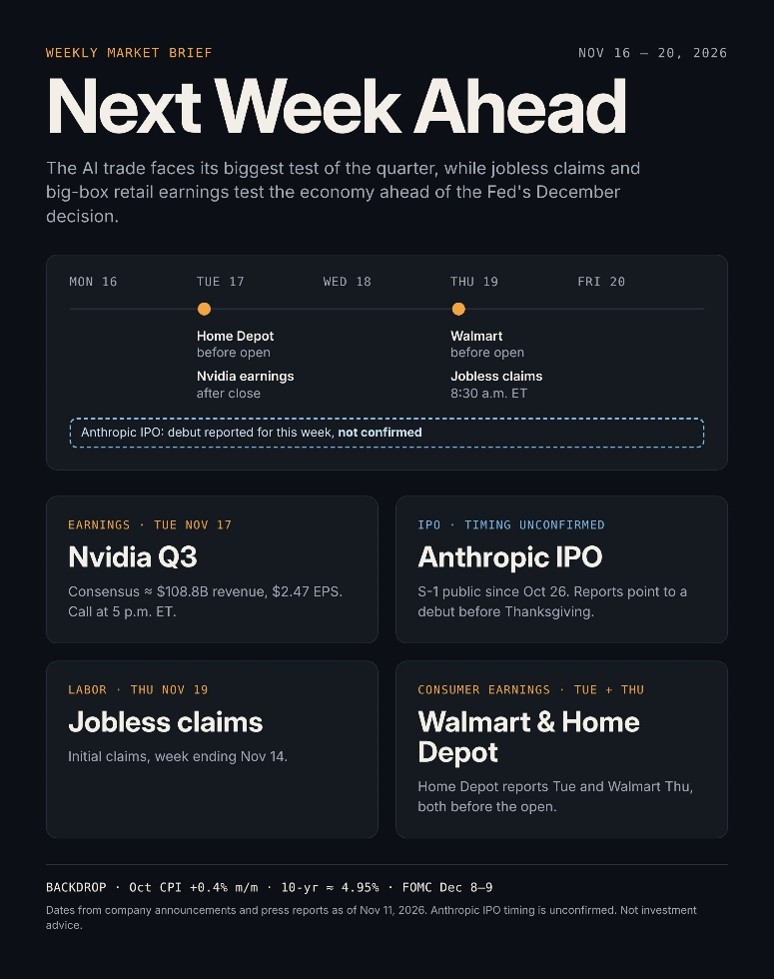
Image created with Anthropic’s Claude
MacNicol & Associates Asset Management
November 13th, 2026
Download in PDF format: