
Share This Post Today!


Bagacay Point Lighthouse, Cebu, Philippines

This lighthouse stands at a height of 172 feet on an elevated 5000 square meter government property. The lighthouse station was established in 1857.
Cabra Island Lighthouse, Cabra Island, Philippines

This lighthouse is a historic lighthouse on the northwesternmost of the Lubang group of islands. The lighthouse was constructed in 1889 and was the first of five first-order lighthouses built by the Spanish.
*Feel free to send us your photos of Lighthouses to be featured in our weekly market observations.
Buying at the wrong time
Despite market wobbles and AI names pulling back in recent weeks for a variety of reasons, including consumer pushback against the buildout of data centers and the elevated spending required, Bloomberg reported that two AI-related companies were in advanced acquisition talks. On Monday, the deal was officially announced, and both companies involved saw their share prices pull back sharply despite a Monday morning rebound across markets.
The deal will see Marvell Technology, a California-based semiconductor producer, acquire Lumentum Holdings, an American manufacturer of optical and photonic products. The acquisition comes at an implied enterprise value of $115 billion in an all-stock transaction. The deal is a fixed-ratio deal with no cash, so the actual value will depend on the price of Marvell shares. Lumentum shareholders will receive 4.5 Marvell shares for each Lumentum share under the agreement. The deal is expected to close in early 2028. The deal as of today would be the largest merger between two public companies ever.
The acquisition is a bet on the continued surge in AI demand and the buildout that is required to support it. The deal values Lumentum at $1,132 a share, a 24% premium from the closing price on October 28th (before Bloomberg reported the two firms were discussing a merger). Marvell’s CEO stated this acquisition will allow the firm to move first and help define the transition toward optical connectivity, something he called a once-in-a-generation opportunity. Companies today are now relying on optical connections to piece together chips used to run and train large language models. The two firms stated that the combined firm would expand to $550 billion.
Marvell shares sank more than 6% on Monday and are down 32% over the last month (as of Monday morning). Meanwhile, Lumentum shares sank 11% on Monday and are down 31% over the last month. Marvell shares have surged in recent years on AI optimism and rose sharply earlier this year after the CEO of Nvidia called the firm the next trillion-dollar company. Investors see this all-stock transition for what it is: a potentially massive deal that will dilute shareholders. The deal closing in 2028 will cause a major overhang on shares over the next few quarters.
This is not Marvell’s first huge bet on AI growth; earlier this year the firm closed a multibillion-dollar deal for Celestial AI.
This deal shows that management across the AI industry is not spooked due to volatility in equity markets and changing consumer/investor sentiment on the AI trade. We think the volatility will continue but expect deals like this one to continue to be announced as the AI arms race continues to unfold. Barron’s labeled the acquisition by Marvell as a “mistake” due to their timing of announcing the deal.
This Marvell and Lumentum deal could impact the view of Tesla shareholders regarding a SpaceX acquisition of Tesla. A pure stock acquisition ties Tesla share performance to SpaceX shares directly, which is what we are seeing with Lumentum and Marvell. However, Tesla shareholders likely want a deal believing in the vision of Elon Musk, which could push shares higher unlike Marvell and Lumentum’s initial share performance.
An update from last week
In last week’s edition of this commentary, we talked about Anthropic’s pending IPO and the details in their S-1 filed with the SEC. This week, the firm updated its S-1. The S-1 showed the firm has $895.4 billion in committed spending, up from $105 billion at the end of last year. The only firm with more off-balance sheet commitments is Alphabet, which has $1.06 trillion in commitments. Anthropic will incur $70 billion in spending in the next 12 months and 50% of the total by the end of 2030. The other 50% will be incurred over the following 15 years. Overall, these long-term commitments for Anthropic were much larger than was expected.
Anthropic’s biggest commitments are to Broadcom ($161.2 billion), Google Cloud, SpaceX AI, and Amazon.
Anthropic’s third-quarter revenue also came in at $17 billion, a 1127% increase YoY. The firm’s compute and infrastructure costs rose 382% YoY to $9.9 billion. The firm reported a $567 million operating loss in Q3 compared to a $974 million profit in Q2. The firm’s operating profit turned negative in the third quarter due to a short-term purchase of compute capacity, which cost more than comparable long-term deals. Once again, as mentioned last week, Anthropic reported an accounting net loss, mostly driven by noncash accounting charges related to financing agreements and convertible notes. Since the first quarter of 2025, Anthropic’s compute efficiency has increased by 4.3x (measured as revenue per dollar of compute). On an efficiency basis, Anthropic now makes more revenue per employee than every Magnificent Seven company except Nvidia.
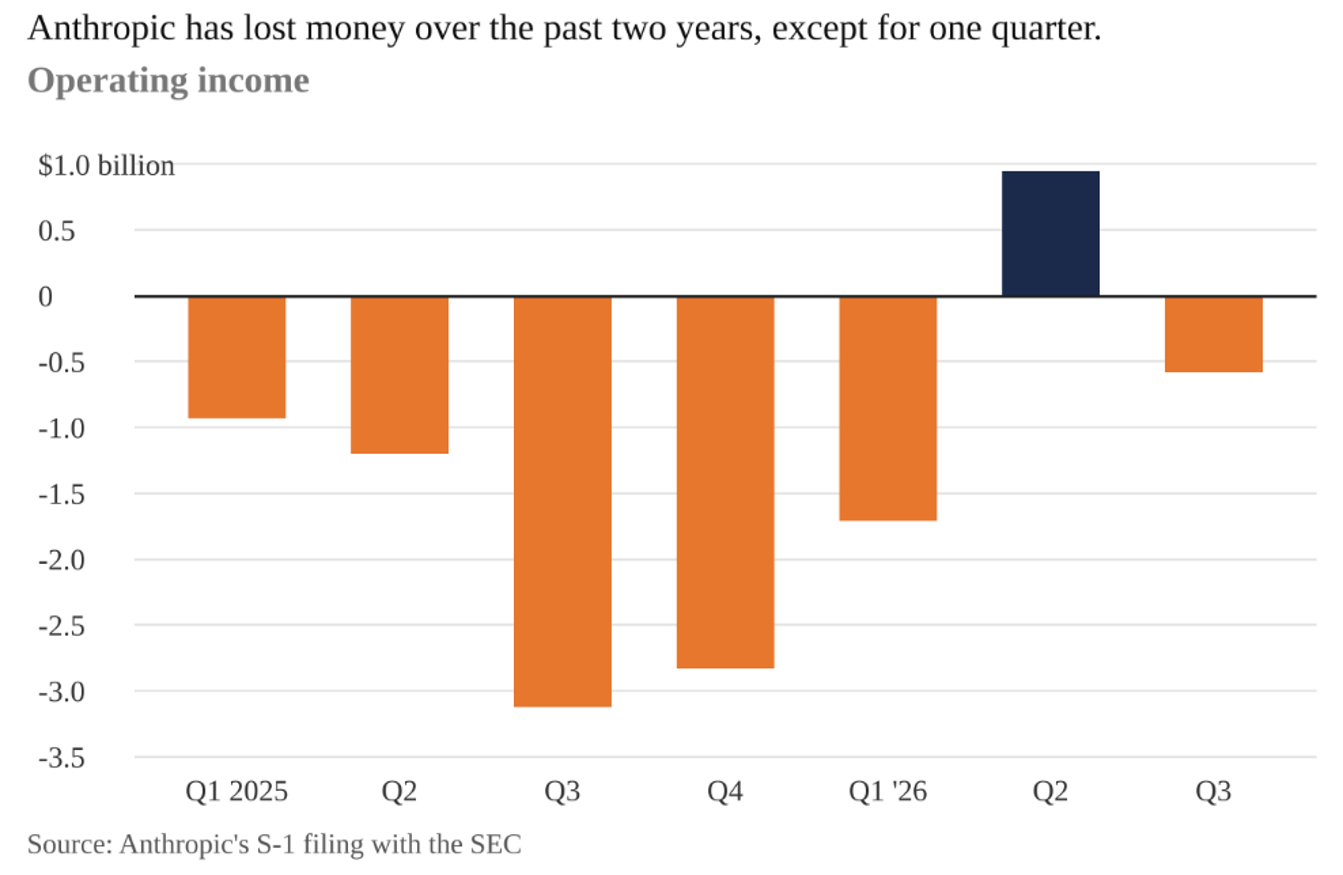
Anthropic’s current annualized revenue comes in at $68 billion versus a spending commitment of $70 billion over the next 12 months. The firm flat-out needs revenue to continue its growth rate to sustain its level of spending. For now, it seems revenue growth is slightly slowing as firms pull back on their token spending due to weakening economic conditions. Despite the 1000% revenue growth over the last year, Anthropic’s quarterly growth rate has slowed over the last two quarters and according to some experts at a fast rate.
In terms of a balance sheet update, not a lot has changed over the last quarter, with Anthropic’s cash sitting at $96 billion and short-term investments sitting at $36.3 billion.
Investors will likely be hyper-focused on revenue growth and operating profits during the fourth quarter as the firm will eventually need to be free cash flow positive to justify the level of spending. As we have said in the past, we do not have a horse in this race as we have no exposure to Anthropic and will not be looking for an allocation when it eventually IPOs, which could come sooner than expected. Expect its performance in its first few weeks to drive market sentiment and potentially overall market performance.
Anthropic shares traded on Hyperliquid decreased by 3% on Monday after this new S-1 was released, with shares down 15% over the last month. The AI selloff has impacted the valuations of more than just public companies, and Anthropic is not an exception. Hyperliquid is a high-performance Layer 1 (L1) blockchain and decentralized finance (DeFi) ecosystem best known for its native, fully on-chain perpetual futures and spot trading.
AI favorite continues its fall
On Monday, Oracle shares dropped by more than 8% after the company announced a $10 billion stock offering to finance its AI cloud buildout. The firm will also raise $10 billion in a debt offering. The proceeds of this new raise will be directed towards capex, debt repayments, and future investments.
The details of this new raise came days after Oracle announced it would commit to limiting additional capital raises through 2030. The announcement came at Oracle’s investor day last Wednesday, where they delivered better-than-expected guidance for revenue and announced a limit of $20 billion in additional capital raising through fiscal year 2030. On Monday of this week, we learned all $20 billion of that will be raised at once and not spread out as many analysts expected. The equity will be raised at an 11.2% discount to Oracle’s closing share price on Monday. Oracle’s debt issuance will vary across five tranches with maturities ranging from 2029 to 2046.
This accelerated spending brings back concern about the mounting costs of Oracle’s AI expansion, which to date has required substantial capital investments in data centers and compute equipment. In September, Oracle disclosed $125.3 billion in outstanding borrowings alongside $288 billion in additional lease commitments, not reflected on its balance sheet. They have financed most of their expansion through external financing.
Oracle is not the only firm with massive commitments. Oracle, Amazon, Meta, Google, and Microsoft now combine for $1.3 trillion in future data center leases, a massive increase from last year; most of these commitments have also been made over the last four quarters.
This new raise caught investors off guard and comes at a time when Oracle did not have to raise new capital. At the end of last quarter, Oracle reported $31.3 billion in cash. The new raise also comes at a time when Oracle Credit Default Swaps have surged in price.
Oracle shares are now down 40% in 2026 and 54% over the last year. That is a serious worry for investors at a time when AI sentiment is driving the market to all-time highs. Shares have pulled back heavily over questions regarding the company’s ability to generate an appropriate return on its AI investments and eventually pay down its debt.
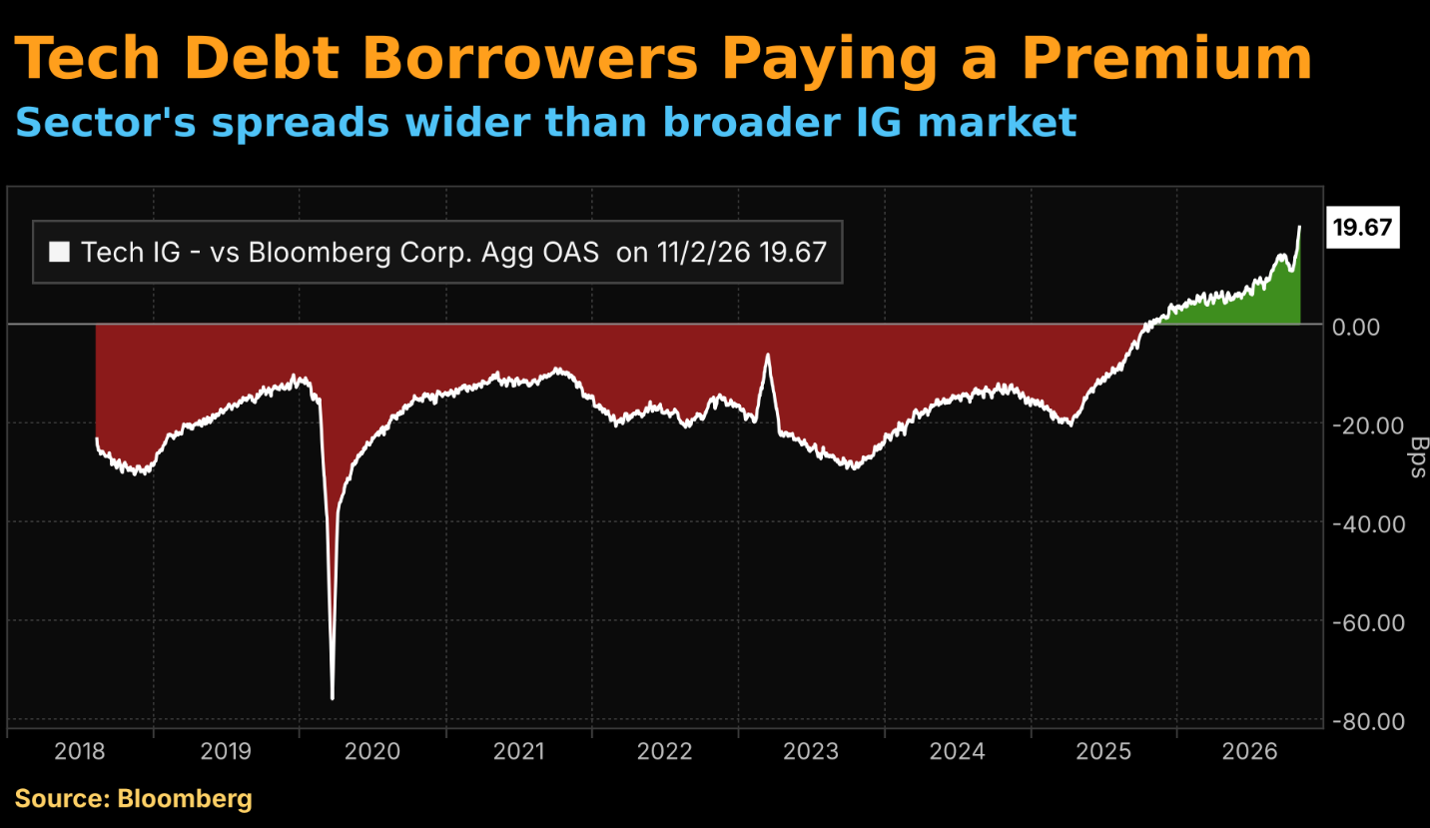
The debt issuances that firms like Oracle, Meta, and other AI-related companies have made borrowing for technology companies more expensive than the rest of the market (for investment-grade issuers). Spreads on technology debt versus the general market are now at their highest level going back to 2003.
Why is that? Technology companies historically have raised capital through equity and generally have some of the strongest cash flows, which decreases the interest rate investors demand. This cycle has changed that fact as investors increasingly have become more worried regarding technology debt issuance and the sustainability of AI-related spending. This has increased the spread described and illustrated above at a rapid rate.
The opinion above is not questioning AI technology and its application or potential. It’s questioning the spending levels and their impact on capital markets in today’s market. We think that this AI risk is not going anywhere and will remain on the minds of investors for the foreseeable future.
Another strong quarter
Williams Companies (WMB), the U.S. natural gas giant, reported strong figures at market close on Monday, pushing shares higher on Tuesday. We have talked about Williams a lot in the past due to its strategic positioning in the U.S. energy industry. The firm delivers nearly one third of U.S. natural gas through its system and will continue to benefit from demand increases for natural gas and power generation.
The firm beat revenue estimates, while adjusted earnings-per-share came in line with average street expectations. Adjusted net income rose 10% YoY while operating cash flows jumped 6% YoY to $1.505 billion in the third quarter. The firm’s adjusted EBITDA through the first nine months of 2026 increased 9% YoY.
The firm reaffirmed its 2026 fiscal year guidance and indicated that they are tracking toward the upper half of the range for adjusted EBITDA. Management also forecasted an 11% CAGR for long-term adjusted EBITDA through 2030.
The firm’s profit increase was driven by expanding pipeline operations, higher storage revenue, and growing U.S. demand for natural gas infrastructure serving liquefied natural gas exports and power generation. The firm’s improved performance reflected its $2.8 billion acquisition of Momentum Midstream, newly commissioned infrastructure, and the company’s expanding power generation business. The Momentum Midstream acquisition enhances Williams Companies’ ability to transport natural gas from production to export facilities. The expansion of projects led to a large increase in William’s capital expenditures YoY; however, the firm maintained its fiscal year 2026 guidance for capital expenditures.
WMB stated that its new project with Meta Platforms gives them confidence in updating their guidance moving forward. Williams is building two natural gas power plants for a Meta data center project in Ohio. The deal was announced in June, and WMB continues to progress.
WMB also announced an expansion to one of its natural gas storage facilities and advanced several projects on its pipeline system. Management stated on their earnings call that they expect to announce an additional two projects by the end of 2028. The new projects are expected to expand Williams’ customer base with long-term contracts alongside high-quality counterparties.
Management expects their recent acquisition and expanding pipeline network to support continued earnings growth through the end of the decade.
In terms of valuation, Williams Companies trades more expensively than its competitors, but that is justified in our eyes due to Williams’ position as a premium pipeline operator. The firm is also forecasted to grow at a faster and more consistent rate than the industry. Williams is also supplying power directly to many data centers through deals with hyperscalers where they supply on-site, behind-the-meter natural gas generation. The firm also has high-quality assets relative to competitors, which also justifies its elevated valuation. WMB continues to benefit from the expansion of AI and the power required for data centers. The company pairs that upside with its core business, which remains resilient and of the highest quality in the industry.
So far this year, Williams Companies’ shares are outperforming the S&P 500 by over 11% (as of November 3rd).
Disclaimer: MacNicol & Associates Asset Management holds shares of Williams Companies (NYSE: WMB) across various client accounts.
Heading into midterms
As we headed into midterms this past Tuesday, the polls and odds markets painted one picture: a blue wave. As we know over the last few cycles, pollsters have dramatically been wrong so we tried to avoid jumping to a conclusion.
All eyes were on exit polls on Tuesday evening for the world’s first view of results. Wall Street analysts were forecasting both the House and Senate to flip, which would cause issues for President Trump and Republicans over the next two years and beyond (Senate terms are 6 years and some of the 2026 races are historically the tightest races in the country). There were also numerous gubernatorial races which many investors had their eyes on.
Our view before the election was that the market’s response would be mostly muted and minimal no matter the result, unless results were not accepted and the election was contested. Financial markets are already dealing with numerous risk factors causing elevated volatility; a gridlocked Washington could be good for markets, bringing some stability to policy. The biggest risk this election cycle brought to markets in our eyes was regarding data centers and their regulation. Numerous democrats have been pushing for more regulation and a pullback on government support; this could negatively impact the buildout of data centers in numerous states, which could slow the growth of AI and potentially negatively impact financial markets. Gubernatorial races where data centers were a key issue were in Texas, Arizona, and Georgia. Data centers were directly on the ballot in 41 communities across the country, which will allow voters to weigh in on data center construction in their local communities.
On to the results!
Unless you didn’t read any news, you already know the results from Tuesday. We will not bore you with details but will say it was an outright Blue Tsunami. This election will have rippling effects in American politics. We think the results reflect voters pushing back against this administration, showing them they do not have electoral blind faith. We think the costly Iran conflict and Trump’s commitment to AI and data centers were huge drivers of these election results. Affordability which Trump promised to fix has unfortunately not gotten any better, inflation resurging due to high energy prices is not helping that!
So, what is next? The Senate and House will be led by Democrats, and the margin is not that close. Two years of Democrats leading in Washington. This will likely bring forth two years of Democrat led investigations, potential impeachments, and gridlock when it comes to policy. There is also a consensus belief that Supreme Court Justice confirmations will be put on pause for two years until Democrats can dominate a candidate. The larger-than-expected victory from Democrats dilutes the influence of smaller hyper-moderate and progressive factions within the Democratic Party.
Trump has already stated he will be in contact with some Democrat leaders regarding common ground and policy. We will not be holding our breath on that one.
In terms of market impact, stocks and metals prices moved higher on Wednesday morning while energy prices and yields pulled back. For the most part, this is bullish for stocks as we get stability and gridlock in Washington for two years. We expect Democrats to push for spending limits (as they will control the budget), an end to the Iran war (limit military spending), and an increase in legislation at state and federal levels for data centers, crypto, and other sectors.
The big loser from this election could be data centers and the AI trade, with many Democrats pushing for a pause or slowdown in their construction or increased legislation across the sector. The newly elected Texas Governor (Democrat) has spoken out against data centers during her campaign, and Texas alone accounts for 25% of planned capacity. Goldman expects a temporary data center construction moratorium across several states due to election results, including in Texas, Georgia, and Michigan. These states could pass legislation that could introduce limits on tax breaks, electricity, water, and environmental permits. However, many expect the moratoriums to be short-lived, especially as Republicans will still control the Senate and House in Texas’s state government. Here are the states that have the largest data center pipelines:
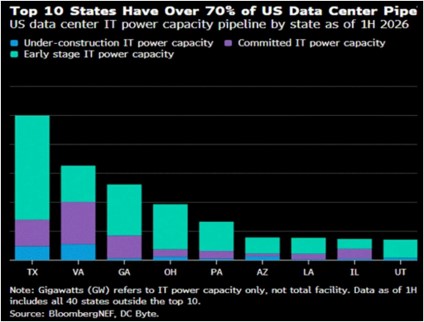
The current Texas Governor (Greg Abbott) placed a data center construction moratorium on September 21st ahead of the election due to the unpopularity of data centers. Analysts believed that if he won, he would ease restrictions and work to change policy without impacting the entire industry. Due to the upset by the Democrats in Texas, there is fear the construction moratorium will not be lifted in the short term. Goldman expects these issues to be short-lived for the AI trade.
Many data center service providers, data center operators, and energy suppliers to data centers saw their share prices pull back on Wednesday after the election results, on initial investor fears regarding the outlook and growth for the AI industry.
At a macro level, investors and tech bros do not realize how unpopular and ignored AI is for the middle class. These data centers are being placed in local communities and are negatively impacting them by raising taxes, energy prices, and negatively impacting the climate.
Beyond the data center impacts, we expect some of the hyperscalers / mega-capitalization technology companies to potentially face investigations, which brings forth a new risk for these firms. We think these firms will potentially face investigations due to their links to President Trump in recent years, with many tech CEOs becoming advisors and close allies of the current President.
What we are watching next week
Next week we will be watching and analyzing several events, including the U.S. election. In next week’s edition, we will be giving some more thoughts on what the next two years look like. We will also be watching the U.S. Bureau of Labor Statistics release of October inflation data on Tuesday. If inflation remains hot and comes in higher than expected, it will also guarantee an interest rate hike from the FED in October. Canada’s inflation data is published the following Monday and will be watched closely as well by investors and the Bank of Canada.
We will also be watching to see if the AI-related selloff that we have seen over the last few weeks and on Wednesday after the election continues. It is also a heavy earnings week with the likes of Constellation Energy, Occidental, CoreWeave, and Barrick reporting over the next week. We expect many investors to watch the earnings of a few AI-related names very closely, given the current investor sentiment regarding the AI trade.
MacNicol & Associates Asset Management
November 6th, 2026
Download in PDF format: