
Share This Post Today!


Faro Blanco Lighthouse,
Marathon Key, FL submitted by Dave and Diane MacNicol



This lighthouse is a 65-foot lighthouse located in a marina in the Florida Keys on the island of Marathon. The lighthouse was built in 1950 and was built for private navigation for boats entering and leaving the marina. The lighthouse has been damaged by major storms over time including in 1960 and 2005.
*Feel free to send us your photos of lighthouses to be featured in our weekly market observations at info@macnicolasset.com.
Anthropic IPO = A TEST FOR THE MARKET
Market performance and sentiment have both been rocky in recent weeks. One of the drivers of that rockiness has been artificial intelligence and the overall semiconductor industry. Investors have begun to question the spending levels across the industry and their sustainability. This has led to the PHLX Semiconductor Index falling 18% over the last three months as the AI trade has turned sour (as of November 16th).
The AI weakness that we have seen in recent weeks continued on Monday, just days ahead of Anthropic’s highly anticipated IPO. The company last week expected to price its IPO on Wednesday before it begins trading on Thursday (a day before this publication is distributed). As of last week, the firm was expected to sell 825 million shares between $70 and $78. The fully diluted valuation comes in at $1.4 trillion when accounting for the likes of options and unvested stock awards. Anthropic got its first rating before it went public on Tuesday morning. New Street Research analyst Pierre Ferragu initiated coverage on Anthropic with a buy rating and a $105 price target (this came before Anthropic shares were officially priced).
According to a report on Tuesday by The Wall Street Journal, shares could be priced at more than $80 per share due to robust demand, and advisers have even discussed a valuation of $1.5-1.6 trillion, well above the initial value. On Wednesday morning, CNBC reported that demand surpassed $500 billion for the IPO, 80% of which was institutional. Anthropic originally only planned to raise $64 billion through its IPO. After the IPO, the 7 co-founders will own 12.8% of Anthropic and 50.1% of the voting shares, while Amazon will own 14.7% (23.8% if notes fully convert), and Alphabet 13.7% after the $26 billion private placement is completed. Other companies participating in the $26 billion private placement include Nvidia, AMD, Broadcom, Micron, Microsoft, and TSMC. Circularity in this industry truly never sleeps….
If you do not believe the hype, look at the pure demand for shares in this IPO and the ecosystem around Anthropic trading publicly. There are already leveraged ETFs for Anthropic, which launched this week, as well as an ETF that tracks the Anthropic ecosystem (customers and suppliers). This could be a very volatile stock over the next few days, which could be bad for markets, as at a $1.4 trillion valuation, it would be the world’s 11th largest public company (in terms of market capitalization).
With markets already on edge, how investors receive Anthropic’s IPO will be a major test. It’s also well timed for drama: the listing lands just two days after Nvidia reports what may be the most important earnings ever. (Okay, we may be a bit hyperbolic there, but not by much.) Before its earnings, Nvidia accounted for 24% of the S&P 500’s forecasted consensus earnings-per-share growth for 2027. Nearly a quarter of EPS growth – 1 company, the market really runs through Nvidia – perhaps we were not being hyperbolic after all.
Nvidia’s earnings were released on Tuesday and came days after CEO Jensen Huang resigned following reports of alleged extramarital affairs and board pressure for him to step down or resign. If either disappoints, it could drag the entire market lower and deepen chip stocks’ woes. The interim CEO for Nvidia is the company’s longtime CFO, Colette Kress.
Nvidia and Jensen Huang have been all over the news in recent days for all the wrong reasons, as beyond the CEO’s departure, the company is reportedly facing numerous investigations, including some from the U.S. Department of Justice. The firm is facing investigations due to Huang’s behavior and possible chip sales to customers with heavy links to China. We will not dive into the details and will not comment on the personal life of the CEO. Our one caveat is that the market is likely overreacting to this news, and shares will likely bounce back in the coming weeks (they are off 30% over the last month).
An interesting wrinkle on Huang and Nvidia was reported on Monday that has nothing to do with the operations of Nvidia or the AI industry; it involves confidence, timing, and tax-free proceeds. Huang and his wife transferred $10 billion in stock into a family trust a month before this scandal became public through a nontaxable transaction (done through a grantor-retained annuity trust).
Plenty of the ultra-rich use these to transfer assets, but according to Barron’s, this transfer was remarkable due to its timing. Huang and his wife funded four GRATs in 2016 after an earnings call, two with four-year terms, and two for ten years. The two 10-year GRATs were funded with $51 million worth of Nvidia shares. The value of those GRATs exploded as Nvidia rose to become the world’s most important company due to AI. The filing doesn’t say which heirs the irrevocable trust benefits, but the Huang’s have two adult children who work at Nvidia. Estate attorneys used phrases like “wild”, “unmitigated success,” and “impeccable” to describe the amount of wealth the Huang’s moved estate-tax free. The GRATs wrapped up in March, and Nvidia shares are down 12% since then, which would significantly decrease the value of the GRATs.
Some might say Jensen Huang’s multibillion-dollar wealth transfer was a stroke of genius. Others would call it unfair. Either way, he got lucky.
Shortly before Nvidia delivered its earnings, Jensen Huang released a statement saying he was open to returning to Nvidia if the Board approves of it. No matter how things between Nvidia and Jensen unfold, expect activists to be involved, agendas to be pushed, and proxy votes to occur (just pure speculation). If he cashes out, starts his own venture, and some ex. Nvidia staff join him, it will be the hottest venture in the world (investors will throw billions at him and his team). This leadership change could also impact Nvidia’s competitive advantage and future growth, as Jensen has led the firm since its founding, driving innovation, growth, and the AI industry through his vision.
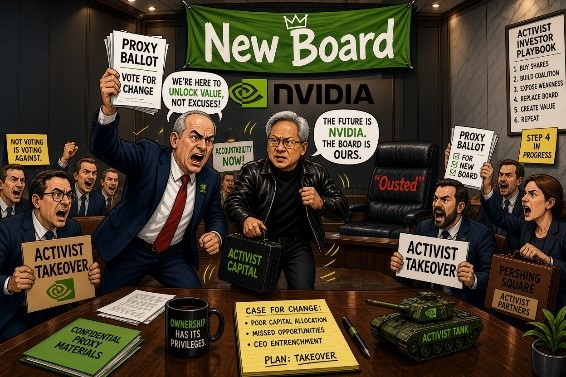
Image is fictionalized, created with Grok AI
Heading into earnings, Nvidia traded at its lowest forward non-GAAP P/E ratio in 14 years at 12.7 times earnings.
Onto Nvidia’s earnings….
The firm reported $115.8 billion in revenue and $2.68 in adjusted earnings, both figures beat street estimates ($2.48, FactSet). The firm’s data center revenue also came in higher than expected and increased 110% year-over-year. The firm’s operating margin came in at 67%, and revenue jumped 103% year-over-year.
Nvidia’s Board approved a $150 billion increase to its share repurchase program (at the end of Q3, its share repurchase authorization totals $227 billion). Management expects the repurchase program to be completed by the end of fiscal year 2028, driven by a forecasted $334 billion in free cash flow next year. The firm reported $65.5 billion in non-marketable equity securities on its balance sheet, more than 8x higher than Q3 of last year. In terms of guidance, management forecast fourth-quarter revenue of $130 billion, $5.1 billion higher than analyst expectations. The firm expects its next fiscal year revenue to jump 75%, up from previous guidance of 70%.
Nvidia reported $550 billion in future commitments, including $390 billion in supply and capacity commitments, a 40% YoY increase. The spend is real whether it is data center commitments, Neocloud agreements, or cloud service agreements; the AI trade does not seem to be slowing down.
The strong earnings print seemed to quiet some questions from investors, but who will replace Jensen Huang remains a key concern for investors, as do the pending DOJ investigations. The Board’s Chairman opened the earnings call by stating that they do not plan to reinstate Jensen Huang. An interesting wrinkle from this earnings call was a lack of color on the firm’s alleged connections to China and potential restrictions they may face; not one analyst asked about the topic on the earnings call. Nvidia did, however, announce they would be stopping shipping their Hopper data center products to China due to national security reasons. The U.S. government previously approved the sale of these products to Chinese companies by Nvidia. Nvidia’s guidance does not include any sales of these products to China, but the firm sold $2.4 billion of these products to Chinese customers in its Q3 results.
After Nvidia’s earnings shares moved up by more than 2% before the market opened and before pulling back to near 52-week lows (down 2% on the day) in the afternoon.
Retail Sales Data
According to Census Bureau data, retail sales increased 0.2% in October, down from 0.8% in September. Retail sales excluding autos rose 0.6%, beating the 0.4% estimate. Overall spending by Americans grew more slowly than expected in October because of rising prices and sluggish income growth. This weakness has led some economists, including those at Morgan Stanley, to slash their consumer spending growth forecasts for the fourth quarter. They now expect an annualized growth rate of just 1.2%, down from 3.8% in the third quarter.
This report comes at retailer’s head into their most important period of the year, holiday shopping season. Consumer spending has remained resilient this year despite affordability issues driven by slowing wage growth and continued elevated inflation. This data shows consumers might be growing more cautious as they feel the pressure on their household budgets.
According to data from Bank of America, household credit card spending rose 5.8% in October year-over-year. However, spending only rose 0.1% month over month and declined in several categories. The same research report highlighted improving conditions driven by decreasing energy prices, strong equity markets, and a low unemployment rate, which should keep consumer fundamentals healthy. Despite an increase in holiday spending YoY, Bank of America is hesitant with their optimism as the share of discretionary spending was lower than last year across all income cohorts. According to the Bank of America consumer spending report, the K-shaped economy is changing, with conditions for the lowest-paid Americans improving. Lower-income households are now leading the way in terms of purchases they make, with holiday spending increasing 9% YoY versus 6% for higher-income households and 4% for the top 5%. Millennials and Gen Z have led the charge in terms of spending increases YoY.
Despite more transactions YoY, these transactions are taking place at lower price points, with spending on big-ticket items declining. The same Bank of America research stated that these declines could start leaking into online shopping. The firm highlighted lower-income-focused retailers as the stronger picks for the fourth quarter versus luxury retail companies. Look for discount retailers, as well as the likes of Walmart, to benefit from inflationary pressures across the economy. Target and TJX most recently reported positive earnings reports as sales accelerate and store traffic increases in the U.S. retail market. Uncertainty across financial markets could also continue to negatively impact higher-income household spending this holiday season, whose financial outlook could impact discretionary spending.
Berkshire 13D
On Monday, many hedge funds, family offices, and other financial institutions filed their latest 13F’s with the SEC for the period ending September 30th, 2026. These filings reflect purchases, sales, and the latest portfolio updates for these firms. We bring this up this week as we talked about Berkshire Hathaway last week, where we discussed their latest earnings report. We wanted to update our readers on the firm’s new public stock transactions and give an update on their portfolio. The filing covers the majority of Berkshire’s $335.5 billion stock portfolio.
Berkshire’s only new purchase was Bending Spoons, the Italian AI company which we reported on last week. The firm increased its stake in Lennar by nearly 100% and Delta Airlines by 12%. The Lennar position was worth over $2.1 billion at quarter end, and the Delta position was $5.4 billion.
In terms of sales, Berkshire trimmed its Bank of America position by $1.6 billion (6%) and trimmed smaller positions in their portfolio, including Verisign, Capital One, Kroger, and Nucor.
Although Berkshire was a net seller of equity positions in the third quarter, Greg Abel, President and CEO, continues to put capital to work as he slowly depletes Berkshire’s war chest of cash and cash equivalents, something Buffett, at the end of his tenure, was hesitant to do. Expect Berkshire to be aggressive with equity purchases in the fourth quarter especially if volatility remains elevated and opportunities present themselves. Buffett prided himself on buying when the street was selling, we expect Abel and the modern Berkshire team to do the same.

Image created with X’s Grok (Greg Abel deploying capital)
Despite all of these purchases, Berkshire’s biggest purchase this year has been Warren Buffett’s favorite stock, Berkshire Hathaway, through share repurchases. We expect Berkshire to be active during the fourth quarter with elevated volatility across markets. However, do not expect their stockpile of cash to be deployed within a few quarters, as it’s a massive amount of capital, and Berkshire traditionally prefers a few concentrated positions over a bunch of small positions where they lack control, and their diversification mirrors an index.
As of Tuesday, Berkshire shares remain within 1% of all-time highs as investors continue to flock to quality equity exposure in today’s risky market. Berkshire’s market capitalization sits at $1.25 trillion and is the third-largest non-technology company in the world (Saudi Aramco, Eli Lily).
S&P 500 pullback
As of noon on Tuesday, the S&P 500 is down 7% from its all-time-high peak reached on October 3rd. This pullback has hurt some investors more than others depending on how their portfolios are structured. AI and technology names have pulled back the most. Over the last month, Nvidia shares have dropped 28%, Alphabet 18%, Meta 12%, Micron 22%, Dell 29%, Caterpillar 22%, Intel 42%, Fortinet 28%, Marvell 38%, and Microsoft 5%. It has been a sharp pullback for technology, and the overall market has been dragged lower with it. While technology names have pulled back, consumer staples, healthcare, utilities, industrials, financials, and many basic materials names are up (some over 10%). We think this trend shows the importance of active management and diversifying across sectors, not just owning the index, which is heavily concentrated in one trade – AI.
This pullback is the 3rd 5% pullback of 2026 and the 34th correction since March 2009. Here is a graphic we recreated that shows all of those pullbacks since then.
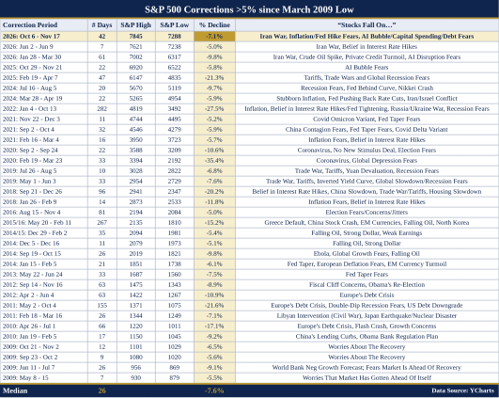
Image recreated with Anthropic’s Claude
The median pullback has been 7.6%, and the median number of days for the pullback has been 26.
Market pullbacks are a normal movement. Investors must accept pullbacks in order to gain from the risk premiums of equities through realized returns. Historically, the headlines change, but the patterns do not.
This is where diversification matters across asset classes and sectors. Diversification does not always stop losses; it makes sure you do not have to sell at the wrong time. A diversified portfolio usually falls less than its worst-hit piece; that is one reason why we historically outperform indices: diversification. The other reason is quality and understanding what we own. We like to own high-quality public companies which we understand thoroughly and do not panic to sell. Our rigorous public equity process removes emotion and is designed to adapt to any type of market condition. On top of that we also diversify across other asset classes, including private real estate, private equity, hedge funds, precious metals, credit, and tail risk protection. We think the combination of these other asset classes and equities enhances returns and decreases risk through diversification across uncorrelated asset classes.
If this approach resonates with you, contact us through email to set up a 30-minute call with one of our Portfolio Managers, who will outline our investment process and portfolio construction approach.
WHAT WE ARE WATCHING NEXT WEEK
After a busy week for markets with the fate of the market being placed on Nvidia’s earnings and Anthropic’s IPO, we head into a short week for the U.S. Thanksgiving. Next week is a light week in terms of earnings with only a few major companies reporting, including Zoom, Analog Devices, and Dell. October’s PCE inflation data released on Wednesday is the main event, as a surprise to the upside could solidify a year-end tightening path with a potential for a 50-basis-point hike. September’s PCE (think Inflation) number was 3.7%. This is the latest major inflation data point the Federal Reserve will get before they meet in early December where the consensus belief is that they will raise interest rates. As markets are closed on Thursday and half of Friday, expect market action to be muted for most of the holiday week. For our readers south of the border, we wish you a happy and healthy Thanksgiving!
MacNicol & Associates Asset Management
November 20th, 2026
Download in PDF format: