
Share This Post Today!


Esaki Lighthouse
Awaji Island, Awaji, Japan

This lighthouse was constructed in 1871 and was eventually automated in 1981. The lighthouse is located within the borders of a national park. It is registered with the government as an “A grade lighthouse” for historic preservation.
Iojimazaki Lighthouse
Iojima, Nagasaki, Japan

This lighthouse was first built in 1871 and was designed by Richard Brunton, a Scottish architect known as “The father of Japanese Lighthouses”. This lighthouse stands at 11.5 meters tall and has a focal height of 211 feet.
THE KING MAKER RETURNS
There is no question that markets have been plagued by uncertainty and volatility over the last few weeks to months. That boiled to the surface last week as markets drew down heavily. Last week the Nasdaq was down 10%, gold 8.7%, S&P 500 8.6%, and the Dow Jones Industrial Average 8%. This was the S&P 500’s biggest weekly decline since 1950, according to YCharts. The VIX surged to 36% on Friday, up 26% for the day. Last week’s 5%+ drop in the S&P 500 is the 32nd occurrence since 2000. It is the first occurrence since the ‘Tariff Tantrums’ of April 2025. Historically, these declines occur in clusters during times of heavy market stress (2008, 2018, 2020, and 2022).
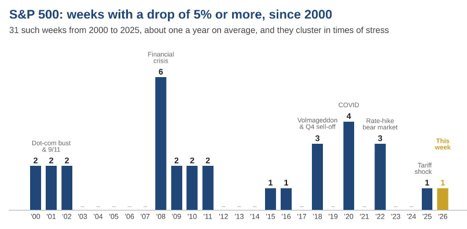
Image created with Anthropic’s Claude
The S&P 500 technology sector declined 12.5%, while every other sector declined last week, with consumer staples having the smallest loss at 2%.
According to market data, the S&P 500 was up 12 weeks after these drops 78% of the time. The median 52-week return after this drop was +18.8%. According to global market data, investors pulled a net $13.9 billion from money market funds over last week while global equity funds took in a net $59.2 billion (as of November 18th) for a 9th straight week of inflows, and the most since mid-June.
On the precious metal front, gold’s weakness continues to be driven by a stronger dollar driven by higher interest rates. The Dollar Index closed at a 19-month high on Friday.
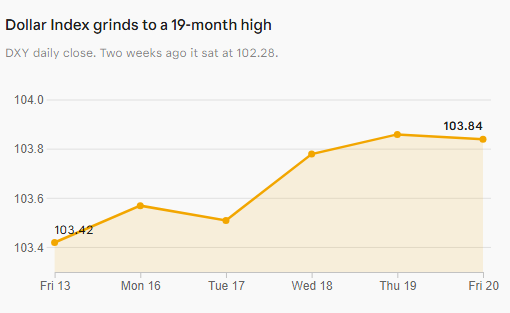
Image created with Anthropic’s Claude
The pullback was led by gold miners and the technology sector. It hit mega caps, semiconductor producers, and almost every sector across the world. The pullback came in the same week Nvidia reported strong earnings, and Anthropic IPO’d (Anthropic shares surged on its first day trading but subsequently pulled back on Friday and Monday). It also came amidst an Nvidia scandal which shook up the company and financial markets. Jensen Huang’s extramarital affair led to his resignation at Nvidia. However, last week he stated he would be open to returning to the company after a review. On Sunday, a few days after markets plunged, President Trump posted that Nvidia’s board should reinstate Huang as Nvidia’s CEO. On Monday, Nvidia’s board did just that. The kingmaker returned (for now).

Source: Zerohedge
The reinstatement of Huang on Monday led to a 30% surge in Nvidia’s share price in the first ten minutes of the market opening. Markets overall also surged, with the Nasdaq moving 5.82% higher by 9:50 am EST on Monday, and even more throughout the day. Broader markets moved higher on this news and pushed most names higher. On Monday, almost every sector was higher (energy, which pulled back due to lower oil prices).
Before investors jump all in on the market again, we will warn readers that some of the market’s best days occur during bear markets. The Nasdaq composite’s best 20 days since 1971 occurred in 1987 (1), 2000 (6), 2001 (3), 2002 (1), 2008 (2), 2009 (2), 2020 (3), 2022 (1), and 2025 (1). Most of these days came while the market was actively moving lower. So perhaps hitting the brakes before going all in on AI and 3x leveraged ETFs would be a smart move in today’s volatile markets.
Getting back to the Kingmaker and Nvidia. President Trump posted online on Monday morning, as the market rebounded in support of Huang’s reinstatement, posting a meme of Huang with the Nvidia flag in an ode to the picture of him at his rally when he was shot waving his fist in the air:
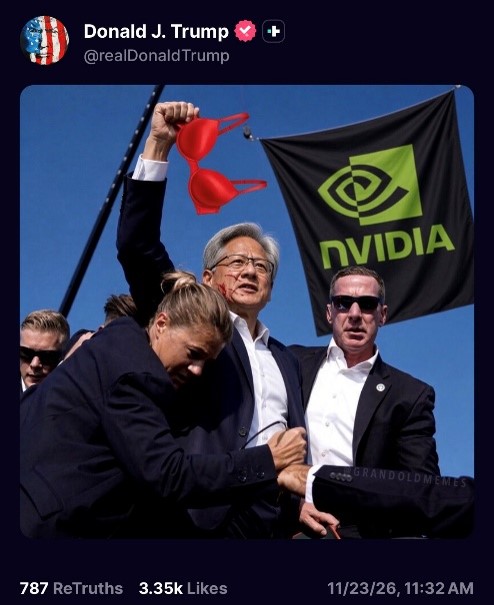
President Trump also went on TV to talk about his support of Jensen and talked about his discussions with the Board.
Nvidia’s Chairman released a statement after the announcement stating, “The Board believes Jensen is the right person to lead NVIDIA, and that his reinstatement is in the best interests of our stockholders, employees, partners and customers.” According to the announcement, the board unanimously reinstated him. The Board stated that they conducted a full review of Huang and, in partnership with the U.S. government, believe he does not pose a national security risk (there were reports that he had an affair with an alleged Chinese spy tied to the Chinese Ministry of State Security). We have no clue what Jensen did or did not do, as we only have reports and statements to read. At a minimum it does seem like he misled his board and management and violated some of Nvidia’s policies through his actions.
These news developments reflect the continued integration of elites across America, in this case the political class and technology oligarchs. It is no surprise to see the government support Huang, the Founder and CEO of Nvidia, as it is arguably the world’s most important company in the AI sector; it is one of the world’s largest companies (in terms of market capitalization), and it is heavily intertwined in every facet of the sector. Nvidia also leads the charge when it comes to U.S. technology and will help it maintain its dominance in the global AI race (something Trump focuses on). Beyond the technology race, there is a financial impact as Trump measures his success as President through the stock market’s performance. In today’s market, performance is highly dependent on the technology sector, and more importantly, Nvidia, so it is no surprise to see his administration support Huang and push for this reinstatement.
We will have to see what happens next and if this bounce continues or if it is short-lived. Huang is set to meet with three House committees for closed-door interviews on December 1st and will publicly testify before the Senate Banking Committee two days later. These hearings could have serious implications for financial markets and could severely impact short-term volatility and performance for Nvidia and the market as a whole.
The last thing we will touch on regarding this market bounce back was a few massive trades on Friday in Nvidia, semiconductors, and underlying market futures, where substantial gains occurred immediately on Monday as the market and technology sector rebounded. Were these trades a coincidence based on Friday’s overcorrection, or were they driven by other motives?
On Tuesday, equities and gold pulled back after one of the strongest days for markets over the last 5 years. Losses were led by Nvidia and the AI industry after their massive jumps on Monday. We expect this volatility to continue and markets to perhaps move horizontally for some time as sentiment remains weak, and the FED potentially begins to hike.
A GOLDEN VIEW
We mentioned the pullback in the price of gold last week, as well as miners leading losses in recent sessions. Many of the miners and the price of gold moved higher on Monday as the market rebounded. This recent price action is cyclical in our opinion and has not changed our investment thesis.
We continue to like gold (and other precious metals) as well as miners for a variety of reasons, including a hedge against inflation, uncorrelated returns relative to traditional assets, a strong store of value, and continued institutional and Central Bank demand. We believe we are still in an inflationary cycle, as inflation in the U.S. remains well above the Fed’s 2% target and has been above that target 67 months in a row. Gold has no counterparty, default, or supply risks, which is why it is held as a reserve asset. Historically, returns are uncorrelated between gold and traditional assets like bonds and stocks, which have seen their correlation increase substantially over the last 5-15 years. According to JP Morgan and Bloomberg data, stock and bond correlation is near its highest point since the mid-1990s based on a 3-year rolling correlation calculation. We also believe there is a floor price for the price of gold due to continued strong institutional demand and the dedollarization trend around the world. In Q3, Central Bank demand for gold increased 42% year-over-year. Goldman Sachs expects 60 tons of Central Bank purchases a month this year, more than triple the monthly number in 2022.
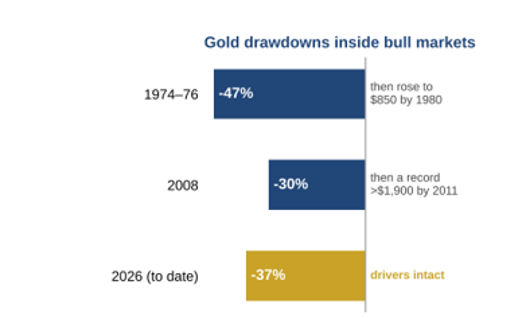
Corrections in the gold trade are also historically common; in the mid-1970s, gold drew down 47% before rallying approximately 750% by early 1980. In 2008, it pulled back 30% before rallying 167% by late 2011. In 2022, the price of gold declined by more than 20% from March to September before rallying more than 140% over the next three years. This cycle’s drawdown was approximately 35% from all-time highs (which we thought was a bit elevated). We bring these past examples up to illustrate the historic rebounds after drawdowns. Banks across the world have also kept their gold price forecasts well above $4000 despite cutting them slightly; JP Morgan sees $4500 and Goldman Sachs $4150 (both well above today’s price).
Created with Claude’s Anthropic
We are not overreacting to this price action, as the sell-off is overdone and our thesis has not changed. We continue to look for rebalancing opportunities in the space for accounts where we are underweight. If things change in terms of inflation and Central Bank purchases, we will reevaluate our investment case and potentially change our view. However, that seems highly unlikely from all of the data we are analyzing.
ANTHROPIC IPO’S IN A ROCKY WEEK
Anthropic IPO’d last week in one of Wall Street’s most anticipated IPOs in years. However, it went public during a very volatile week. The stock originally IPO’d at $83, higher than the original range management was targeting ($70 to $78 per share) due to strong demand. Last Thursday, shares opened at $11.5 and briefly passed $115 before closing at $97.17. This implied a 17.1% return on its first day of trading while the S&P 500 lagged by more than 2%. The next day, Anthropic shares pulled back to $88 while the S&P 500 was down 3.7%. On Monday, when markets rebounded, Anthropic shares moved lower and closed a few bucks over its IPO price before falling below $83 per share on Tuesday to $81 as of lunchtime Tuesday and below $80 on Wednesday as markets pulled further back. Anthropic’s pullback this week led to the potential loss of its current trillion-dollar valuation.
It has been a very rocky week for shareholders in Anthropic and those who participated in the IPO. For investors who participated in Anthropic as private investors, they are still up and likely riding out the volatility or waiting for their shares to unlock. However, the entire market has been rocky, and we would warn investors that Anthropic’s performance is likely being at least partially impacted by weak market sentiment and the pullback that we have seen. There is also the trend of large IPOs flopping or moving down slightly in the months after going public due to elevated valuations. Historically, shares of these firms move higher in the years following their IPO.
SpaceX shareholders have been on a rollercoaster since going public in the spring and are now down 6% from its offering price. Meta shares were down 31% from their first close in their first year of trading, with a max drawdown of 54%. Uber shares lost 21%, Coinbase 55%, Lyft 65%, Rivian 67%, Robinhood 74%, Snap 26%, Alibaba 30%, DoorDash 13%, Dropbox 24%, and Spotify 3% in their first year (relative to their first closing price). Many of these firms have seen their share prices multiply since. While there have been many losers at the top of the IPO market, we must note that there have been a few winners after one year including Palantir, Airbnb, and Snowflake that IPO’d in two weeks in September 2020 and Arm Holdings in 2023. These four IPOs occurred after markets moved lower and had begun to rebound with extreme bullish sentiment from investors.
So why do we say all of this? It is important not to overreact and get emotional when it comes to early performance, especially when the market is overreacting. That is also important when positions move higher. As asset managers, we always try to remove the biases and emotion to allow ourselves to remain logical in any type of market environment. We did not participate in the IPO of Anthropic and usually avoid purchasing shares from institutions in these events, as history tells us shares could pull back, and there will likely be a better entry point over the following year.
We do, however, have exposure to Anthropic shares through a private equity secondaries fund that our private equity fund, the MacNicol Emergence Fund, holds. Our entry price was well below the offering price of the IPO and is subject to certain holding restrictions. For those of you unfamiliar, a secondaries private equity fund buys existing stakes in private equity funds or specific portfolio companies rather than committing capital to brand new funds. It gives sellers liquidity on an illiquid asset before shares go public. We think in the right circumstances, it’s also lower risk than traditional private equity investing as there is earlier liquidity, lower blind-pool risk, and a shallower J-curve.
INFLATION, INFLATION, INFLATION
This week we have remained relatively macro with our comments due to the market pullback and investor sentiment. Next week we will cover a few companies that reported recently, like we usually do in this publication. We wanted to finish off this week with some more macro discussions, this time on inflation.
On Wednesday, it was reported that the PCE price index rose 3.8% YoY as of October, an increase of 0.2% from September. The PCE Index has risen the last four months on a YoY basis. The Core PCE’s annual rate also climbed in October and came in a bit higher than economists surveyed by FactSet expected.
This inflation reading all but guarantees a quarter-point interest rate hike from the FED in December. After a rocky few weeks for markets, there was growing hope that the FED would delay an interest rate hike to bring stability to markets and the overall economy. However, we think that was false hope from uninformed investors as the FED has no mandate to bring stability to financial markets, there mandate is focused on price stability and the jobs market. The FED meets December 9th for its next interest rate decision. This strong inflation reading could help shape expectations for how far they will have to raise rates in 2027.
The two risks facing markets are related. The AI investment boom that has helped power economic growth and stock market gains is also contributing to inflation. Economic growth is the main driver for equity markets, and the strength of the U.S. economy could impact the case for stocks in 2027. If the economy turns over, the FED could pause its 2027 hikes to prevent the economy from slipping into a recession. Wednesday’s report also showed a slight moderation in consumer spending compared to last month, which could be an early sign of the economy turning over. We will have to wait and see for more data points, as will the Fed, to see how resilient the U.S. economy can be in today’s environment.
The PCE index has long been described as the Fed’s favorite indicator for inflation. For those of you who do not know, the PCE (Personal Consumption Expenditures Price Index) is a measure of the prices that people living in the U.S. or those buying on their behalf pay for goods and services.
THANKSGIVING
We want to wish our readers south of the border a happy and healthy Thanksgiving. We hope you have a great holiday with family, friends, and great food. It is important to check out and spend time with loved ones around the holiday rather than watching your portfolio like a hawk (especially when markets are closed).
WHAT WE ARE WATCHING NEXT WEEK
After a short week this week for markets, next week could give us some guidance on the state of the market after last week’s drop. The Nasdaq is officially in bear market territory after correcting more than 20%, while the S&P 500 is more than 10% off all-time highs. The hardest hit names have been AI companies, but this pullback has impacted every sector as investors rebalance their portfolios and take some risk off the table. Next week’s action will give us a glimpse of how markets will behave as we head into the final few weeks of 2026.
Next week we are watching a few things very closely, including on Monday when Canada releases its third-quarter GDP numbers, U.S. job openings on Tuesday, the U.S. jobs report on Friday, and a few other economic indicators. On the earnings front, it is a big week for Canadian banks, which all report at the end of next week, as well as Salesforce and Snowflake. These software earnings reports could give us some guidance on whether AI is squeezing software companies.
MacNicol & Associates Asset Management
November 27th, 2026
Download in PDF format: